Absent from the Reef and other Videos

As part of my “Eyes on the Reef” campaign series to help people engage with, and discover the amazing diversity that local coral reefs support, I present the following videos:

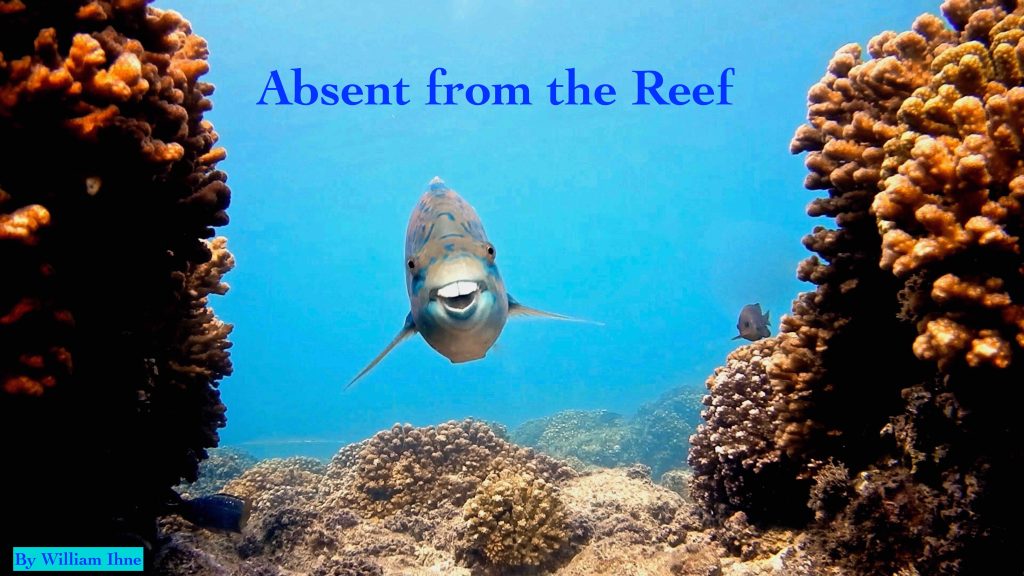
  • My latest, Absent from the Reef, a video tribute to the tremendous adult reef fish schools that once lived at an El Sargento Coral Reef in 2018. The video has a little bit of everything, including fish ID opportunities as resident fish are named, important research data from Mexican Marine Scientists, and it reveals a population baseline for adult fish living at a healthy reef.

    The video asks us to consider the future for local El Sargento reefs, which are some of the most northern coral reefs in North America.

    Here’s a Spanish version of Absent from the Reef! Please share it with your friends.

  • If you enjoy observing and identifying local Eel species, then 10 Eel Species of Baja will help you learn their names. Eels are fascinating creatures. Though at first glance, it’s easy to be alarmed, when a Moray approaches with mouth wide open! Don’t fret, their open mouths help them breath as they pull water inward through their gills. Eels won’t bother you, unless you threaten them. However, I saw one get smacked on the head by another fish, didn’t seem to care. See that smack in this video, Discover Fish Behavior.

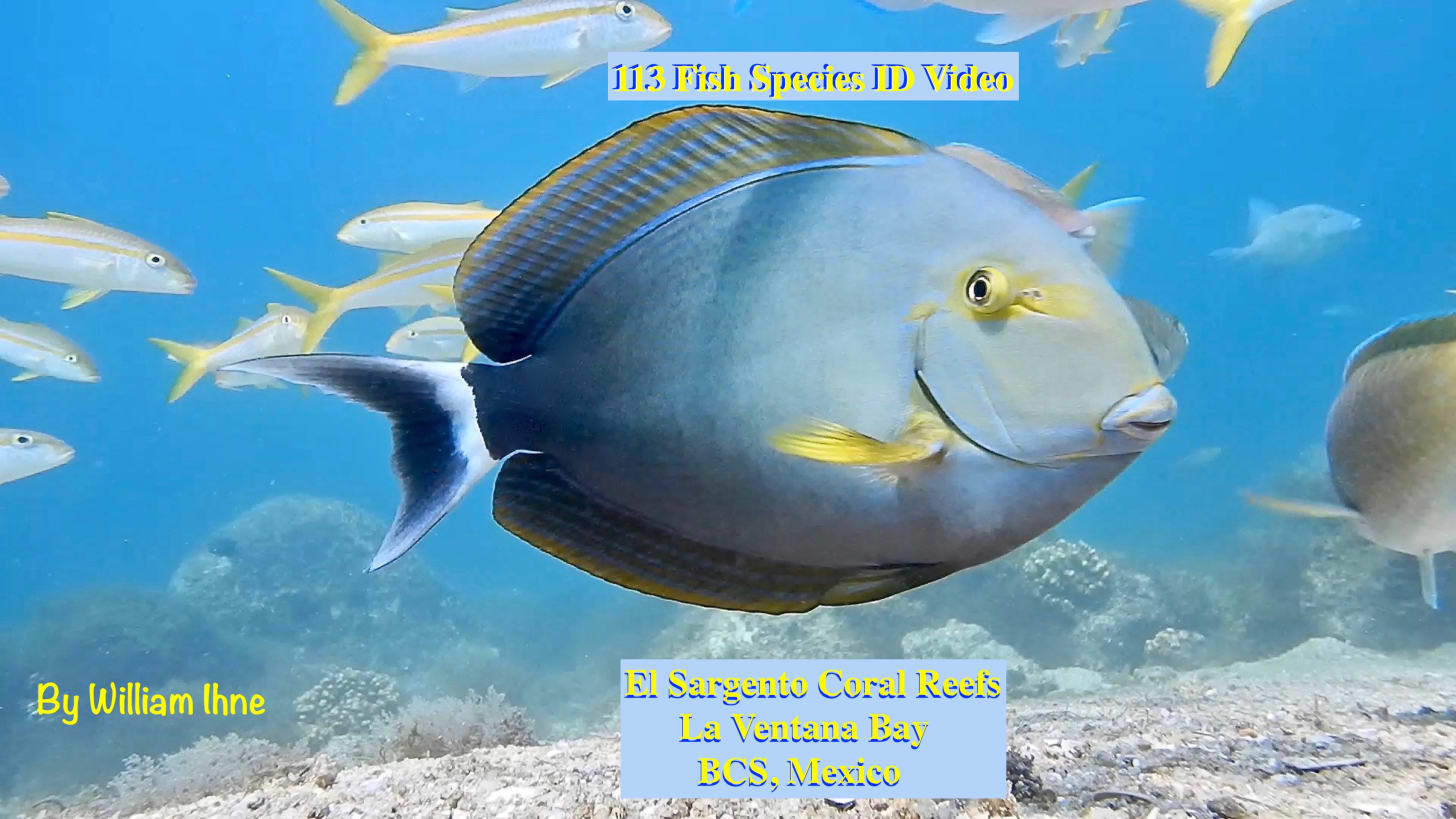
  • If you didn’t have a chance to watch my video post two weeks ago, click here: 113 Fish Species ID, a video to help you learn the names of the fish. Keep in mind, you can turn off the music, turn yours on, change the playback speed, make it loop. You can also test your memory with fish name links in the video description. 

  • Here’s a fun short video. I have never seen two Giant Porcupinefish near each other, ever! Watch these remarkable reproductive moves, very much like formal dance. Eye catching!
Parrotfish (herbivores) prevent algae overgrowth which is beneficial to coral.

If you’re interested in going on a Coral Reef Tour with a Marine Scientist, contact me at desertplayer@hotmail.com. Also, to access my public archive posts on the Ventana View, click on this link, Observing the Reef. Bookmark it to keep up with the latest posts, older ones too.

See you at the reefs! Thanks, William

113 Fish Species ID

Here’s a new video, 113 Fish Species ID, which is both a tool for learning, and a tribute to the biodiversity found at or adjacent to three El Sargento coral reefs. (Photos gathered fr. 8 years, 1000 snorkels.)

Four ways to use the Fish ID Video!

  1. Just let it play, enjoy the show.
  2. Turn off the sound, turn on your music, adjust playback speed on viewer (slower/faster), set on loop to repeat (rt. click)
  3. Hit pause on fish you want to examine more closely.
  4. Test your memory by clicking the fish name links in the video description!

This post is part of a series called “Eyes on the Reef,” a campaign to encourage community education, awareness and engagement with coral reef habitats.

Consider going on an “El Sargento Coral Reef Tour” with a Marine Scientist while the bay water is still warm. I am collecting names for those interested. I’m sure their fee will be reasonable. I’d be glad to assist tour leaders upon request.

This beautiful Yellowfin Surgeonfish changes color as you’ll see. Click on the photo to watch the video.

Thank you. If you have any questions, feel free to comment on the video or email me at desertplayer@hotmail.com or whatsapp 52 612 204 5156 also, to go on a tour. Enjoy!

The Great Big Fish Story, Again!

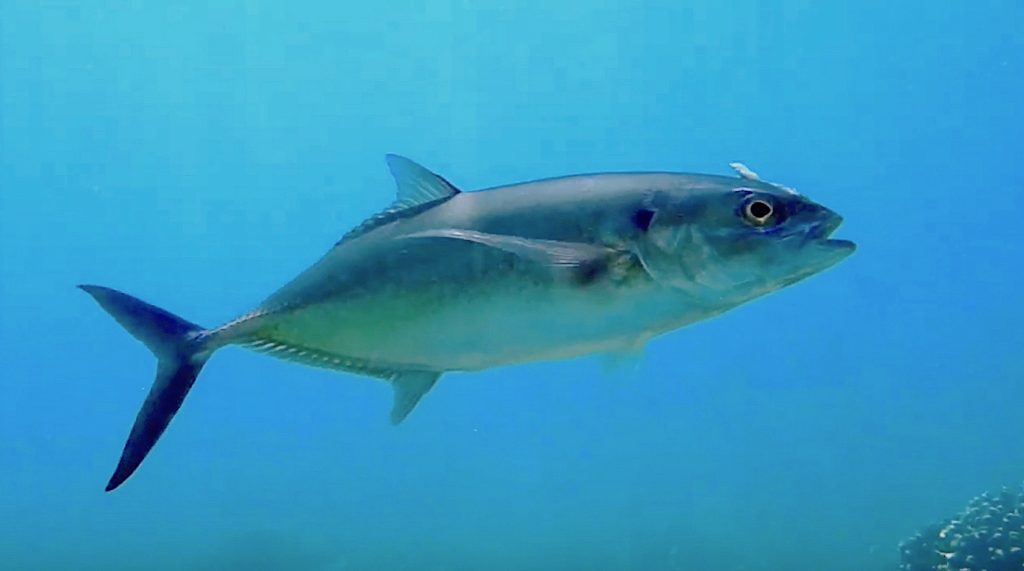
Here’s a true big fish story I wrote that takes place on Cerralvo Island when a monster Roosterfish hammered my fly while standing on the western slope of the desert island. This is one of two stories I’ve written about great fish I’ve encountered. Each made me introspective, considering what impact I want to have on the decline of the largest fish, which are important breeders producing the most and largest eggs and sperm. 

Read it here (on your phone) or here (on your computer).

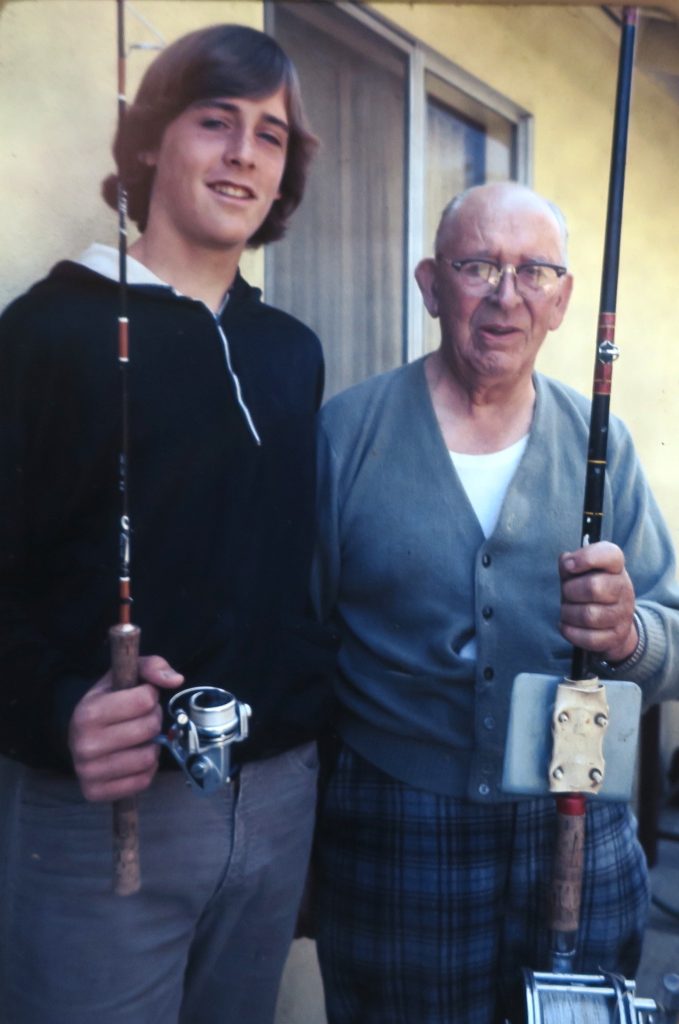
I have always loved fishing, starting at age six lake casting with grandpa. He dragged me on ocean charters, starting two years later. When he was too old to fish, I hiked into the Ojai mountains to catch trout for him to eat when he lived with my family. On my tour to choose a university, I spent two weeks on the Klamath River trying to fulfill grandpa’s request that I bring home a salmon. With the salmon, iced in a trashcan, I did a drive-by of the campus, carelessly snapped a few photos to prove to mom I saw the campus. Humboldt had nature and the fishing I dreamed about. 

Today, my attention is turned to documenting and observing fish living around local coral reefs. What I learn, I share locally on the Ventana View in my Observing the Reef column, or on my YouTube channel. Observing Baja Coral Reef Fish. I enjoy discussing reef ecology, please share your questions with me, I probably won’t know the answer to many, as I am not an expert, but together we can learn more about the sea. 

Would be great to hear from you. Contact: desertplayer@hotmail.com.

William

A fishing team with their fishing rods- Doc Hawkins Minnesota Conservationist, Veterinarian (89) with grandson William (16).

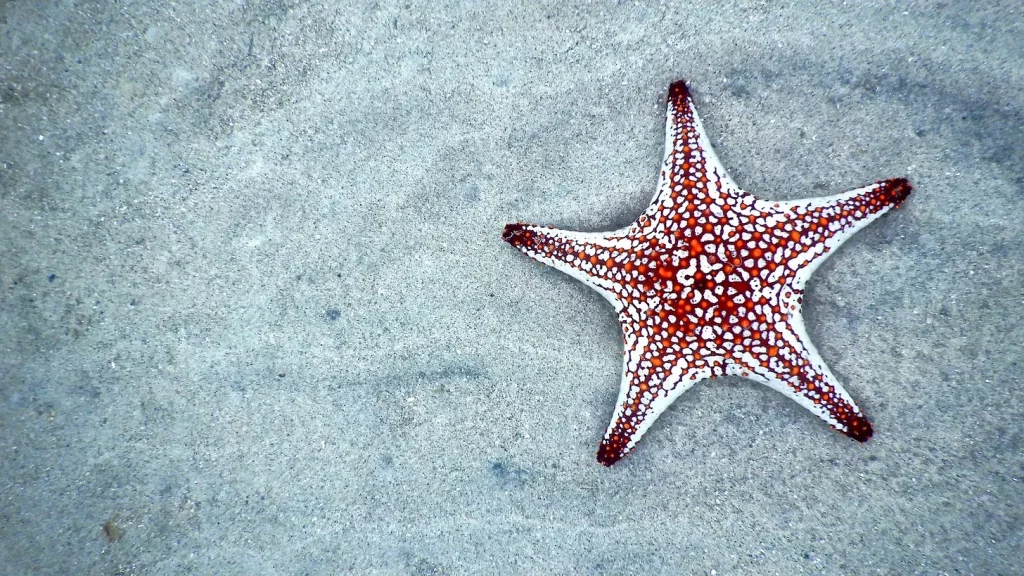
Starfish Diversity in La Ventana Bay

This video; Starfish of La Ventana Bay, shows the amazing biodiversity within this class of Marine Invertebrates known as Starfish or Sea Stars, showing morphological differences in size, color and design between each species. The video utilizes post production time-lapse to show how starfish move across the sea floor with an army of legs. Click here to see video. William’s videos can be found on his Youtube channel, Observing Baja Coral Reef Fish .

Oarfish on the Move: Multiple Sightings Reported

Oarfish, the deep water “serpent-like-children’s-fairytale-book-looking-fish” rarely seen at the sea surface, have been sighted 4 times from the East Cape to La Paz over the weekend. One live sighting, and three beached Oarfish that were deceased, posted on social media. 

The live Oarfish sighting was filmed swimming offshore of Punta Perico mid-way between Punta Arenas and Bahía de Los Muertos. See the video footage taken by captain Eduardo León.

A second Oarfish was found beached, unfortunately, deceased, near Punta Arenas March 27th. It was estimated to be 10 ft long. See documentation of location and close up video of the fish sent to us by Brandon Wells. A third Oarfish was confirmed dead and beached in La Ribera just north of Cabo Pulmo, and a fourth met the same fate at Coromuel Public Beach in La Paz. We have no reporting beyond that on these two events.

Not a person on the planet has the answer to why Oarfish get stranded. Let us work together to figure this out! 

Check out Oarfish Rescue, and Swimming with Oarfish, to observe Oarfish behavior to learn more about them. In them, they are navigating unfamiliar territory. Comment on what you notice there. 

Our Oarfish Beaching Awareness Project group chat has assembled a team to gather information about Oarfish beachings, take samples of deceased Oarfish organs that can be analyzed. In order to accomplish this, we need to get word early-on of Oarfish beachings to get a fresh sample. This sampling can help us determine if this rare fish has been impacted by natural or man-made toxins. For now, we can’t answer why they are becoming stranded on beaches. By working together, maybe we can figure this out, or nudge the discussion a little. 

We appreciate any information the public can provide, including photos or videos should you encounter one or if you have encountered one in the past, we’d love to hear from you!

To report an Oarfish beaching, please include the following 5 things, if possible! Thanks. 

Location, Time, Date, Length, photo

Send to William at WhatsApp 52 612 204 5156 or desertplayer@hotmail.com

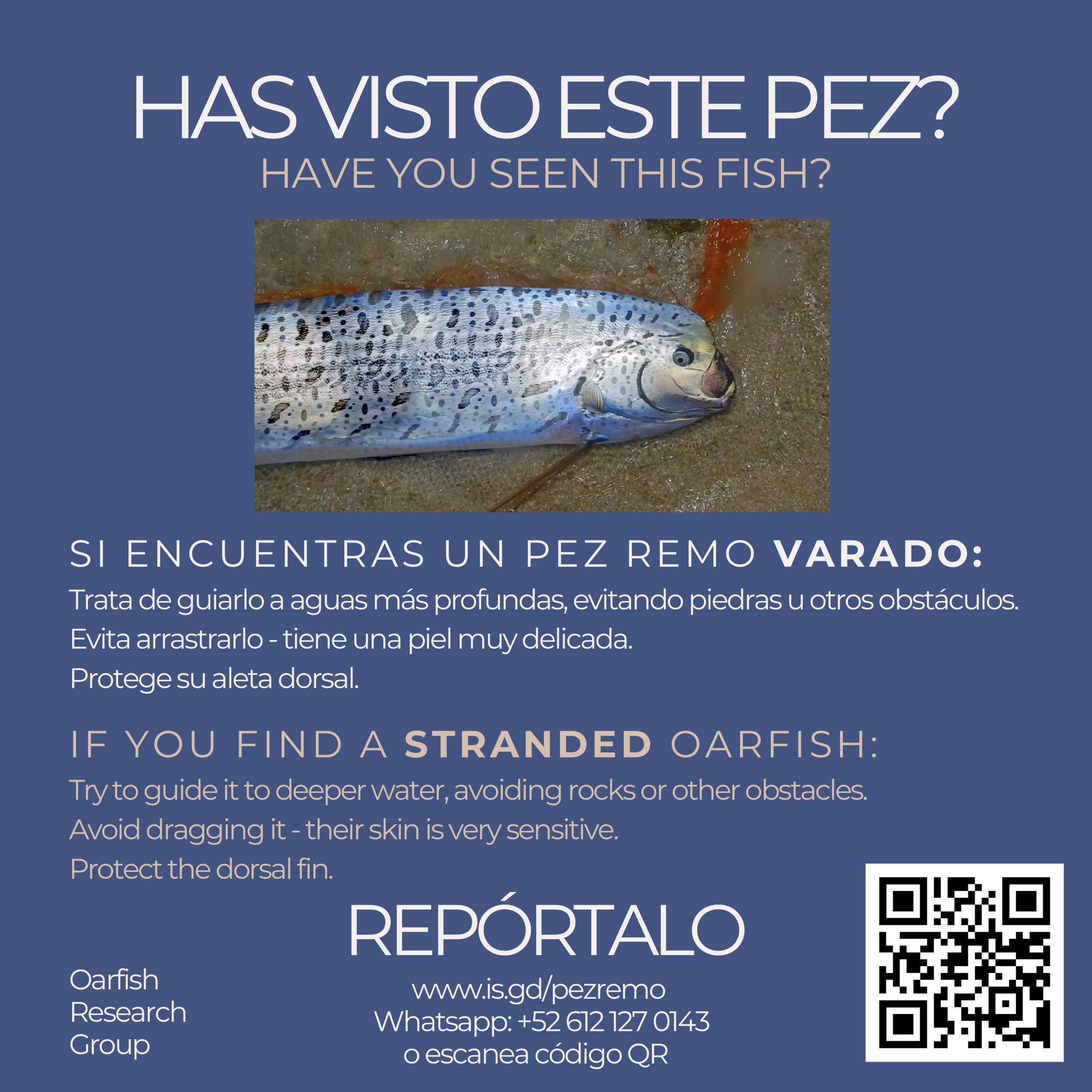
We have an instructional video  “How to Rescue an Oarfish”  (Spanish version) in case you should find one alive on the beach and want to return it to the water. Oarfish are extremely delicate and easily harmed during rescue attempts. The video can help reduce this type of unintended harm. 

Visit Observing Baja Coral Reef Fish to learn more about the local coral reef ecology. 

Thanks to Ron Czarnecki for helping w/a rewrite of my 1st draft!

Breaking Oarfish News!

I will be sharing a video from my Oarfish Rescue Video Series at Baja Joe’s Film Festival on Sat. March 8th& Sun. March 9th at 6:30pm. Please come join in on the fun. I’ll be at both events. 

There was a recent Oarfish beaching in Baja California Sur reported in an article in People Magazine, even made it all the way to the NY Times! Thank you to those who have been passing along articles to our Oarfish Beaching Awareness Project Whatsapp group. There is a more recent article in Forbes Magazine that debunks the “Doomsday Fish” theory, which is, that Oarfish are being driven from deep water onto our beaches by earthquakes.(links to articles highlighted above)

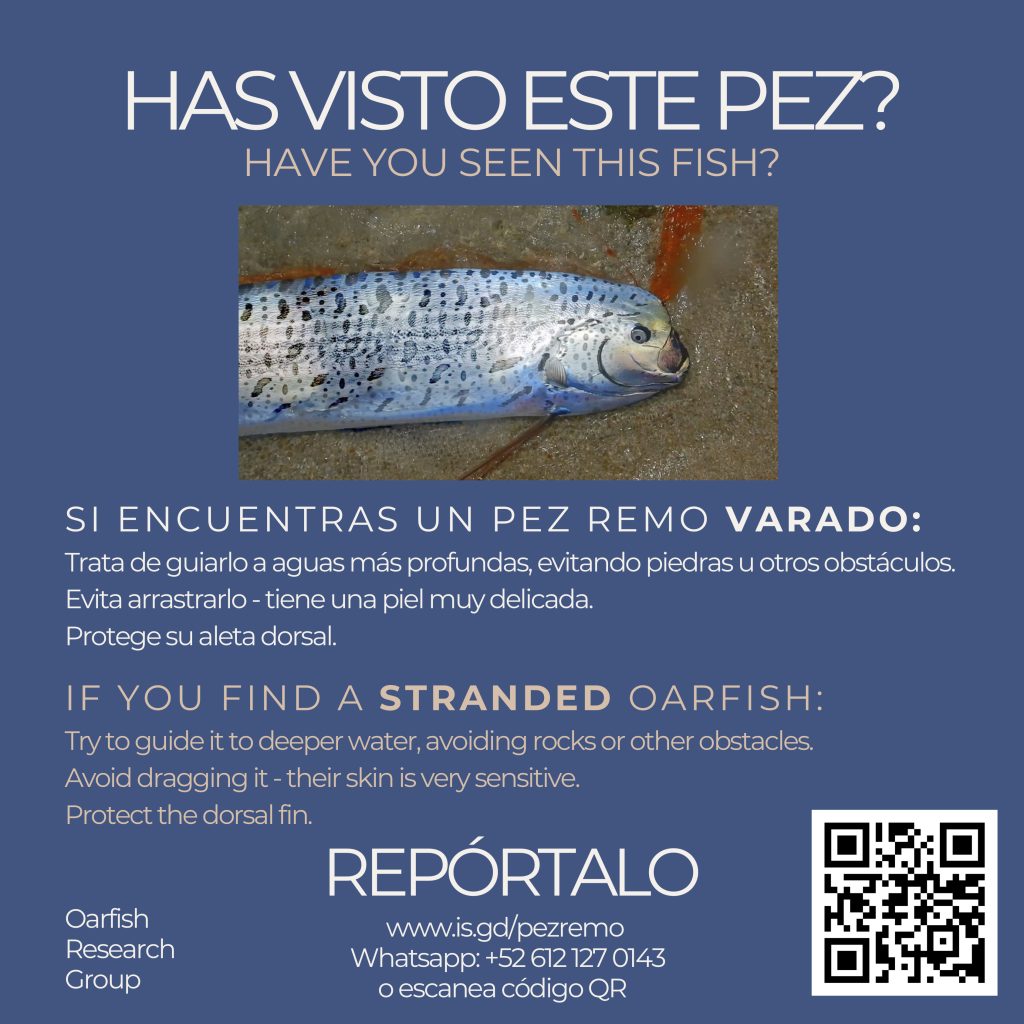
Our Oarfish Beaching Awareness Project group is collecting data on beached Oarfish, so if you run across one, or hear of one that was stranded, please call or message me. William 52 612 204 5156. Here is our poster you may have seen around town that explains how to report an Oarfish Beaching. 

We are collaborating with a senior researcher at CICIMAR- the National Marine Research Institute in La Paz, to provide samples of deceased Oarfish for analysis. If you watched the “How to Rescue an Oarfish” video, at the end there are photos documenting a huge Oarfish beached in El Sargento from 21-years ago. Felipe Galvan-Magana, took samples of that Oarfish to analyze at his laboratory at CICIMAR, where he’s worked as a researcher for 43 years. 

We want to provide Felipe with more Oarfish samples for his analysis, so he can find out if the Oarfish are being impacted by environmental toxins either natural or man-made. To help him get to the bottom of this, we are collecting a list of people to help take Oarfish samples, preserve them under ice, and find a way to get them to Felipe in La Paz. Having a list ensures our chances someone is available should we receive word of a beached (dead) Oarfish. If you’re interested in helping, please contact me. Together, we can learn more about this amazing fish. 

Hope to see you at the Baja Joe’s Film Festival, March 8th & 9th.  William Ihne 52 612 204 6156. Naturalist videographer, underwater explorer/observer, writer. Coordinator for Oarfish Beaching Awareness Project, Observing Baja Coral Reef Fish, Youtube channel.

Oarfish Rescue Video Series & Beaching Awareness Project

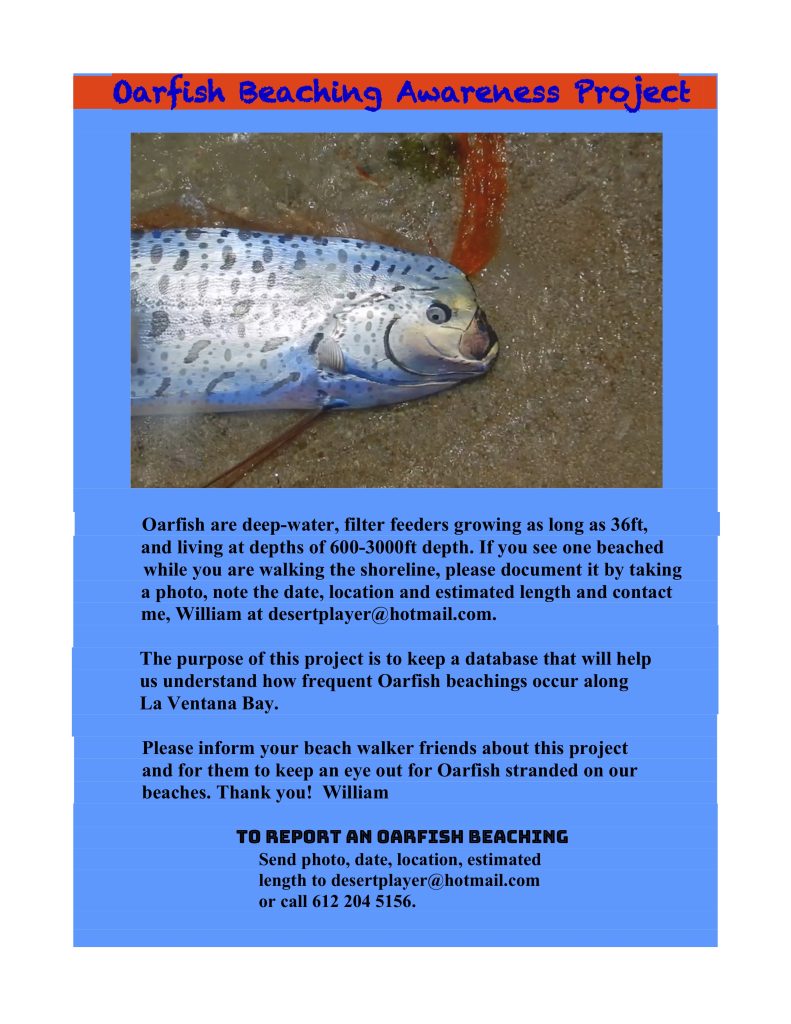
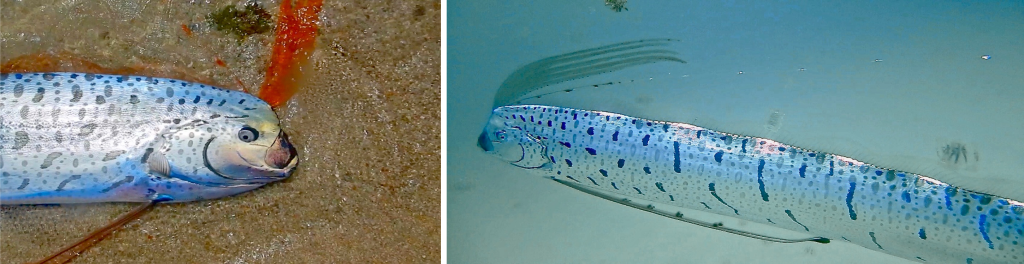
What’s an Oarfish you may ask? Here’s what they look like.

Oarfish are rare deep-water filter feeders that live at depths of 600-3000ft. and grow as long as 36-feet. Sometimes, they get beached along the shoreline. I’ve had two encounters where I swam each fish out to sea, as documented in Oarfish Rescue (Spanish: Recate de un pez remo) and Swimming with Oarfish (Spanish: Nadando con los peces remo). In both, the behavior of this fish is on full display as it responds to and navigates a shallow water environment. Very little is known about this fish, but by observing their behavior in these videos, we learn more about them, and can attempt to answer the most common, basic question at the center of the great mystery surrounding this interesting, one-of-a-kind fish; “Why do Oarfish get stranded on our beaches?”

A third video How to Rescue an Oarfish (Spanish: Cómo recatar un pez remo) instructs how to save an Oarfish without harming it, drawing on experience, using footage from two rescues, introducing how/where to report an Oarfish beaching. At the end, see photos of a beaching that took place 21-years ago in El Sargento when a 14.5 foot Oarfish landed on the very same beach where the aforementioned videos were filmed. 

Oarfish videos in Spanish:

Here’s the link to a playlist of all videos in English and Spanish: Entire Playlist-Oarfish Rescue Series – English and Spanish.

Here are two poster links in Spanish and English announcing “The Oarfish Beaching Awareness Project” whose goal it is assist those who want to help beached Oarfish, and to provide information on how/where to report stranded Oarfish. This data will help us determine the location and frequency of Oarfish beachings, and help us learn more about this amazing fish. 

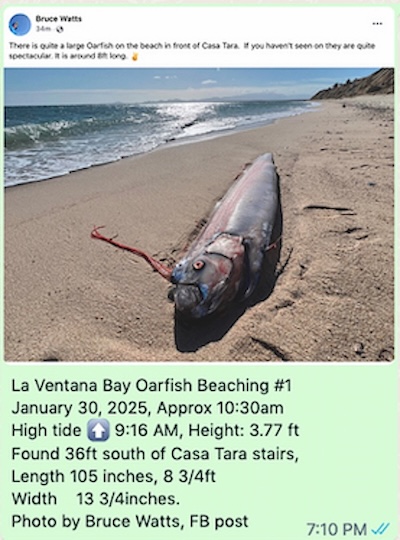
We received our first 2025 Oarfish beaching report,  when a stranded Oarfish died along La Ventana Bay. See the report below. A thank you to Bruce Watts  for taking the photo!

It is my hope that the learning we do together will somehow benefit this unique and special deep-water fish.

Thank you, William Ihne  – Oarfish Beaching Awareness Project Coordinator.

To report a beaching: 52 612 204 5156 WhatsApp, desertplayer@hotmail.com

Coral Bleaching Event – One Year Later

I’ve observed/documented the coral reefs and fish communities along La Ventana Bay shoreline since 2016, logging 1021 snorkels, sharing videos to inform, pay tribute and express gratitude. Many feel similarly about the coral reefs, hoping they will remain healthy and continue to support marine life. 

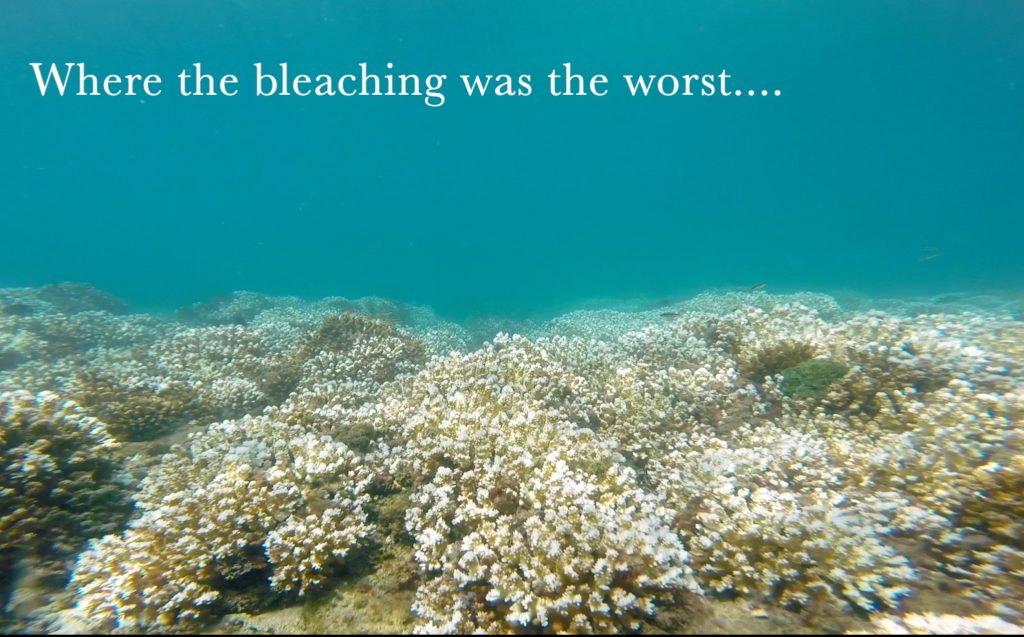
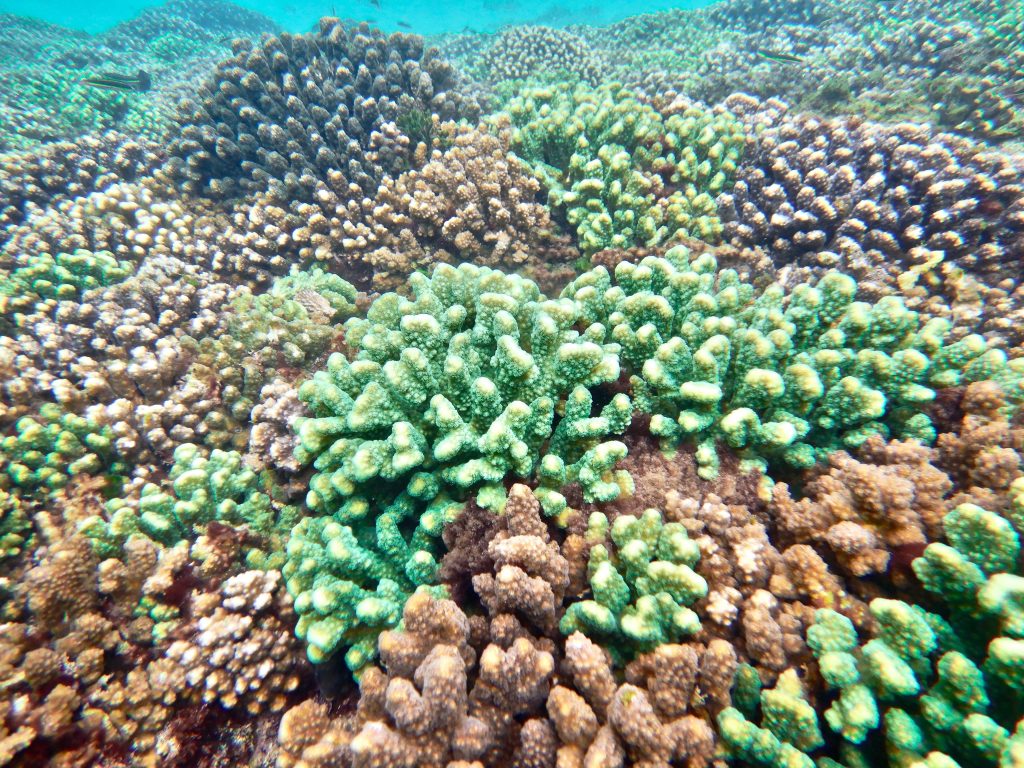
My latest video, “A Coral Bleaching Event- One year later,” shares the extent of coral bleaching recovery in La Ventana Bay since the bleaching event of 2023. Watch, “A Coral Bleaching Report” video to learn about the degree of bleaching that occurred that summer.

What caused coral to bleach? Water temperatures peaked above the bleaching threshold for two-straight months. While the coral recovered, for the most part, our precious reefs are still at risk; facing all the stressors that unprotected coral reefs face around the world, especially those adjacent to rapidly developing communities. 

The coral reefs in La Ventana Bay are one of the furthest north reefs in North America and are very unique due to this range among other important reasons to ensure the protection of these reefs.

2023 delivered a significant bleaching event impacting coral reefs in La Ventana Bay.

Coral provides habitat for 25% of the world’s fish, supports a level of biodiversity comparable to the Amazon Rainforest. I set a camera near coral, not a wide-angle but one with a very narrow field of view, in ten minutes 25 fish species were recorded. We are gifted to be able to witness such diverse communities of marine life, and the coral is essential to that. As they say, lose the coral, lose the biodiversity, the same with clear cutting rainforests.Visit Observing Baja Coral Reef Fish to learn more about the fish and coral reef habitat in La Ventana Bay. To track water temperature fluctuations, visit Aqualink

This spring, I plan to lead a few coral reef tours. If interested, let me know, and I’ll alert you of the dates. Thanks. William Ihne, Naturalist, videographer, writer, producer Contact: desertplayer@hotmail.com