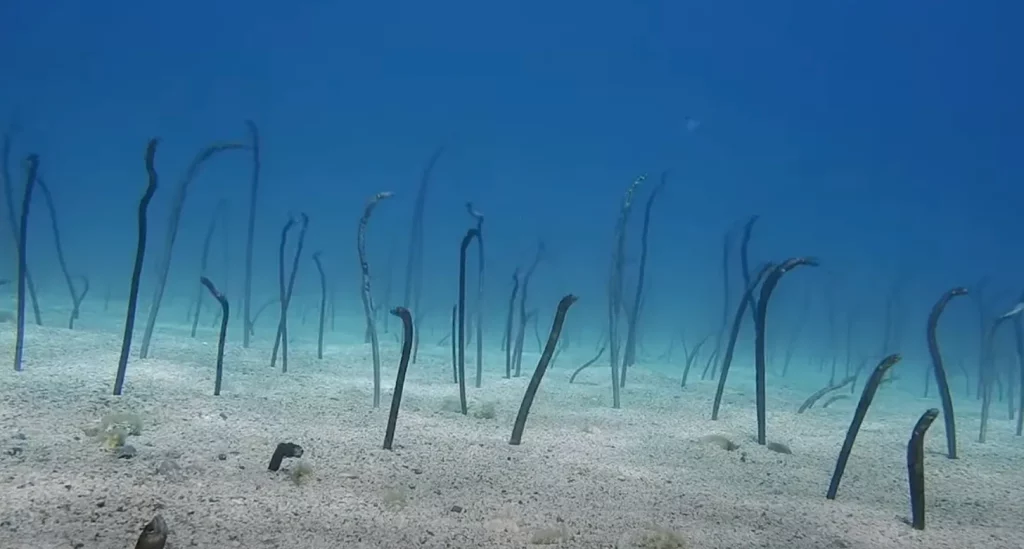
Ten Eel Species of Baja. This video introduces ten saltwater eel species living in La Ventana Bay located in the Gulf of California in Baja California Sur, Mexico. There are two eel species I have only seen once over 760 snorkels. Those are the Redsaddled Snake Eel, and the Pacific Snake Eel. The other I rarely see is the Zebra Moray, and when I do see it, it retreats beneath a rock, and stays put for longer than I care to wait. All the rest, not including the Garden Eels I see repeatedly go beneath rocks in search for food. Often a few species of fish can be seen following the eels and waiting for them to reemerge from under the rock or coral. William desertplayer@hotmail.com
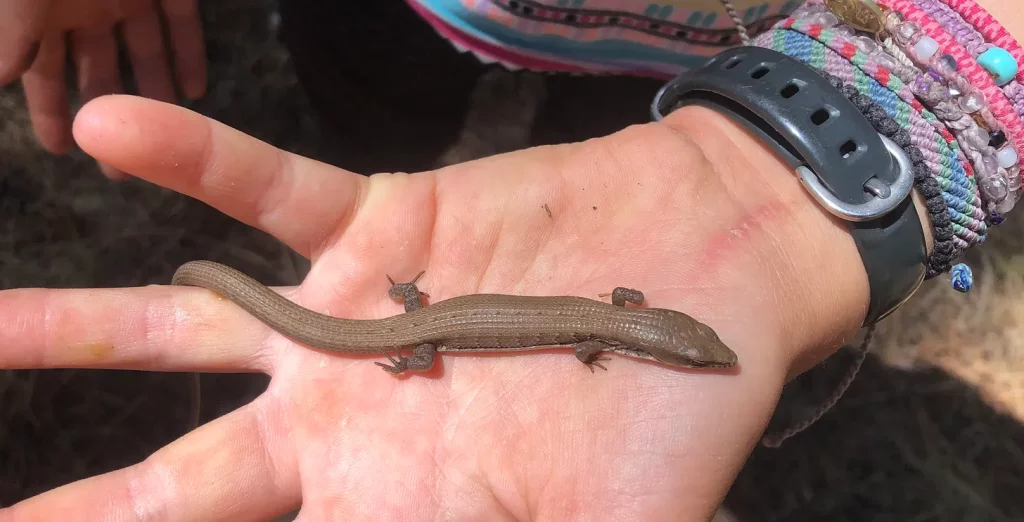
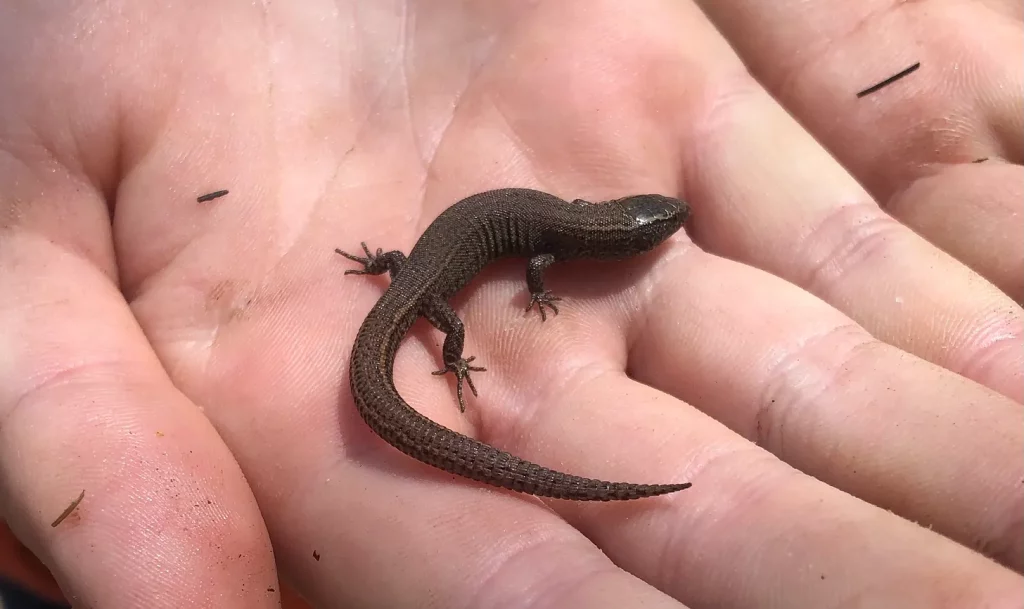
San Lucan Alligator Lizards (Elgaria paucicarinata) are striking, sneaky and extremely long-tailed lizards that inhabit many of the mountainous regions throughout the Baja Cape Region.
Here in LV/ES, alligator lizards are not really present. However, just above us in the hills of Rancho Cacachilas, alligator lizards live their secretive lives. They can be found throughout the Sierra de La Laguna, as well as a few other mountainous regions. They like to live in well-vegetated areas and grassy habitats.
These lizards are typically brown with some red or black markings. They have large mouths and expressions that perfectly mix those of grumpy old men and plotting evil geniuses. They are typically diurnal (active during the day), except for particularly hot days, when they may emerge at dusk or later. They like to tuck their front legs against their bodies and sort of slither through grass. Many individuals have very long tails, sometimes twice as long as the bodies, although they will drop them quite easily. Alligator lizards eat mostly insects, and those of larger carriage may even eat small mammals and birds.
For people from the West Coast of the USA and Canada, alligator lizards might look familiar since they live throughout much of California, Oregon and Washington, as well as southern British Columbia. Although these West Coasters are different species, they are all quite similar in appearance and behavior. – If you want to talk or walk reptiles, email ChanceStevens123@icloud.com
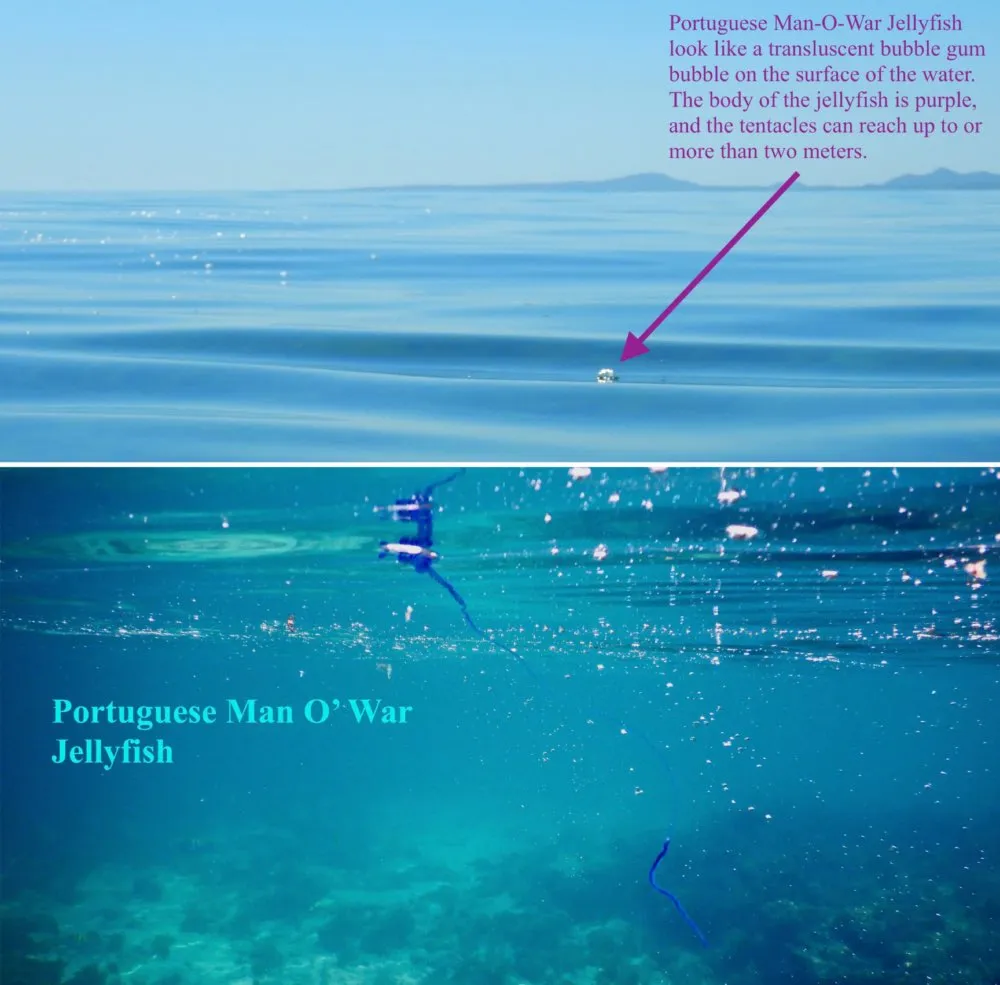
If you are swimming or snorkeling, be on the lookout for Portuguese Man O’ War. Monday, May 21st, we had a boat load of them in the water during one tide. The most I have seen. The next day, snorkeled at the same time, but a different tide, back to normal. Just a couple seen during a long distance snorkel. William desertplayer@hotmail.com
It is now May, and reptiles are out in abundance, including the exuberant Desert Iguanas. (Dipsosaurus dorsalis). From late spring to early fall, they are arguably the most common lizards in Baja. During the winter months, they burrow down into the earth and seem to evaporate out of existence.
Desert Iguanas exhibit one of the most dramatic seasonal changes that I have ever witnessed. For example, last June, on a day trip to Isla Cerralvo, I could not take a step without scaring at least one iguana, and then that iguana would run for the nearest bush and stir up three more iguanas. Such insanity was a big surprise because, when we had last gone to Cerralvo just a few months earlier in March, I hadn’t seen even one iguana. I can’t help but think that, in the winter, Cerralvo’s earth must be 50% iguana.
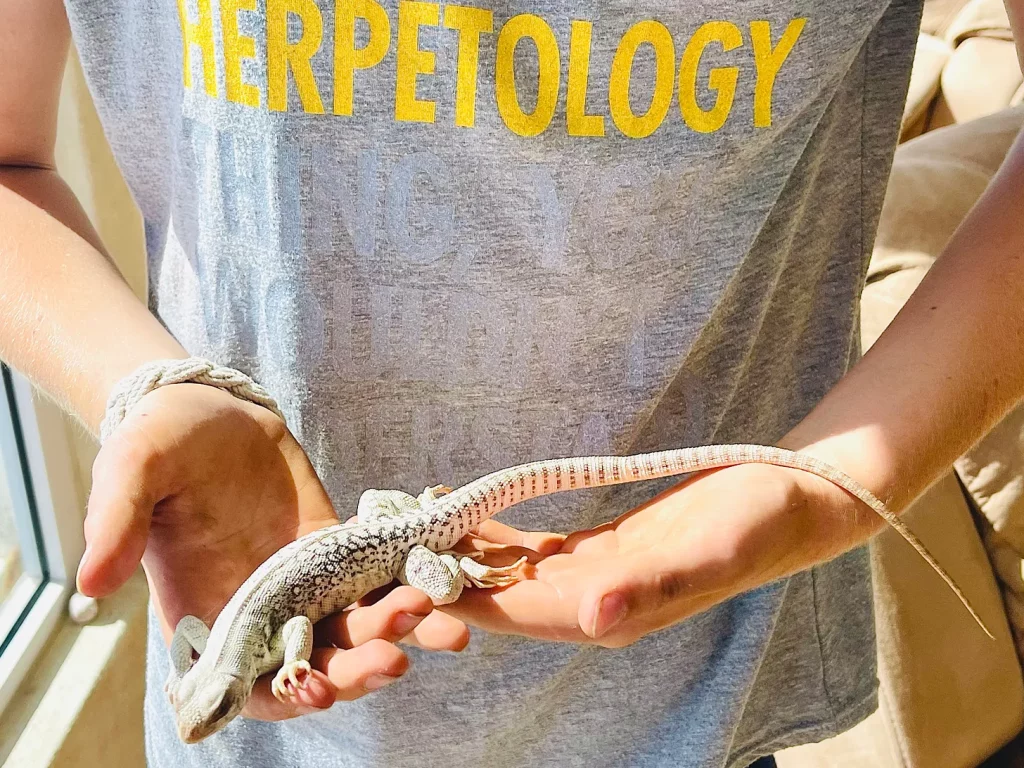
Desert Iguanas are somewhat large lizards that range from cream-colored to grayish-brown in appearance. Individuals can change colors a little, depending on their temperature. They eat mostly leaves, buds and flowers, although they will occasionally eat insects as well. When they are out, you can see tons of tracks littering the dirt roads, which are made as they drag their large tails through the sand, scampering from bush to bush.
Part-time residents of La Ventana may never see Desert Iguanas, since these lizards are just as seasonal as many of the humans. – If you want to talk or walk reptiles, email ChanceStevens123@icloud.com
This week, I am visiting some awesome friends in Northern California. I know many winter residents of La Ventana return to California, Oregon, Washington or British Columbia, so this week’s column is about the reptiles of the Northwest and how they compare with the reptiles of Baja.
As I am originally from Bend, Oregon, the reptiles of the High Desert are close to my heart, so we will start with them. The more arid climate regions of the three US states host Baja equivalent reptiles with some slight variation: racers replace coachwhips; gopher snakes lose their vibrant oranges and reds; rattlesnakes get moodier; and fence lizards are everywhere! Even the little Short-Horned Lizards are similar to the Baja Horned Lizards.
Moving on, we enter the enchanting forests extending throughout much of the Northwest. From Oregon to Baja California Sur, California King Snakes thrive for over 1,000 miles. Ring-necked snakes hang out under bark and rocks, as well as garter snakes – so many garter snakes! Exhibiting a similarly impressive show of adaptability are the gopher snakes, which range from BC, Canada, to BCS, Mexico. Little rubber boas also inhabit the forests throughout the region and are related to the rosy boas of Mexico.
Although these reptiles are all different, they share one common fact: throughout the entire West Coast, only rattlesnakes are dangerous. – If you want to talk or walk reptiles, email ChanceStevens123@icloud.com
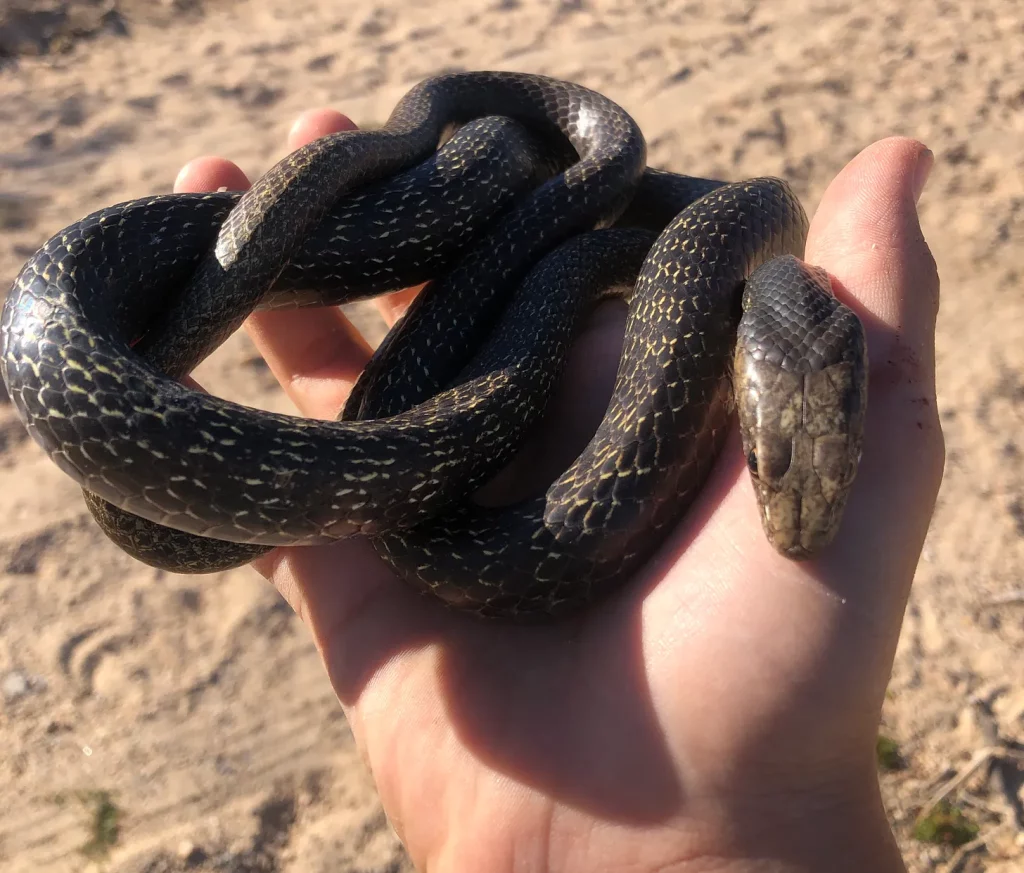
It is now mid-April and the snakes have truly emerged. Here in La Ventana and El Sargento, the most common snakes are definitely Baja California Coachwhips (Masticophis fuliginosus). I have already written a column about coachwhips but I think it is time to revisit them.
Coachwhips are long, thin snakes that come in a variety of colors; around here, they are usually all black, though they can be yellow, silver, white, brown or even dark green. These little lightning bolts are truly expeditive, achieving nearly the most electric speeds of any snake.
Coachwhips are beautiful snakes and completely harmless, although they are quite large, sometimes reaching over two meters (or seven feet) in length. Interestingly, coachwhips are strictly diurnal, meaning they are only active during the day. They have large eyes and actively hunt their prey, even during the heat of the day. They seem to prefer lizards, although they will eat rodents, amphibians, birds, large insects and other snakes.
If you see a coachwhip, you will likely only have a minute to observe it, as they seem to always have a convenient exit solution, utilizing either adjacent brush piles or spontaneous teleportation.
A good example of this took place a few days ago when I was looking for snakes above El Sargento with my friend. We were driving down a small calle near Pitaya when we saw a fresh snake track spanning the road. We followed the track to an isolated bush in the middle of a cleared field and saw a young coachwhip laid out underneath it. I approached the snake, and it let me get within about two feet, before launching itself into an alternate dimension. We searched unsuccessfully everywhere around the bush and ultimately concluded that the snake no longer existed. We then continued on down the road.
We came back about 20 minutes later to do one final search. We checked the bush thoroughly and found nothing. I then noticed a small brush pile, far across the clearing, and went to investigate. Sure enough, there was our coachwhip sitting smugly in the outer branches.
We spent the next half hour relocating the brush pile and finally caught Houdini. – If you want to talk or walk reptiles, email ChanceStevens123@icloud.com
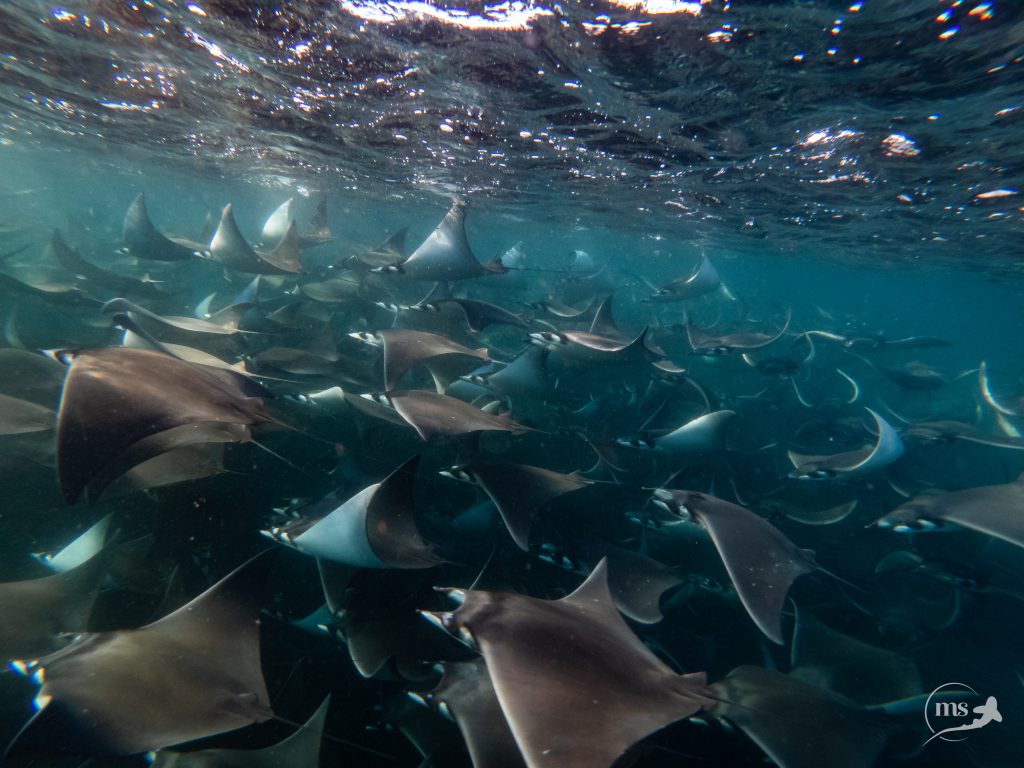
It is that time of the year again! Every spring we have a very special gathering in our front yard: thousands of rays aggregate in a breathtaking spectacle. They are Munk´s pygmy devil ray or Mobula munkiana, locals know them as “tortillas”, because the sound they make when jumping out of the water, reminds the clapping of hands produced while making tortillas.
They are cartilaginous fish, related to sharks, and they inhabit the Eastern Pacific Ocean, from Mexico to Peru. They reach a maximum disc length of 4.2 ft (130 cm), with an average of 3 ft (100cm). They are filter feeders, and they follow the zooplankton blooms, moving around the Baja peninsula with them. This time of the year, they can be seen in our area, when the conditions are ideal for feeding and reproduction. All around the bay, they can be seen swimming gracefully in the water, hundreds of them together, moving their fins like birds flying, it is truly nature´s wonder. But they can also be seen out of the water: moving their wings and gaining enough momentum to propel themselves in acrobatic jumps, sometimes many of them at the same time. Nobody knows exactly why they jump, there are different theories, but I like thinking it is just pure joy.
For years they were fished till they were put in severe danger of extinction. They are very sensitive to overfishing because they have slow reproductive strategies, like many other cartilaginous fishes. They are aplacental viviparous and they only give birth to one pup, after a gestation period of 12 months, so it takes them a long time to recover after the removal of many individuals. Now they are protected, and we have seen increasing numbers, but they are still listed as vulnerable in the IUCN Red List. One of their main threats is bycatch from coastal fishing nets. Swimming with them is a great attraction for ecotourism, making them way more valuable alive than dead and favoring conservation efforts.
Red Diamond Rattlesnakes (Crotalus ruber) are beautiful, large and amazing snakes. They are quite common right now, crossing roads and paths all over Baja. It is April and the snake season has truly begun!
If you are a mountain biker or runner, or find yourself driving on dirt roads through the desert, you probably have already seen some kind of snake this year. Spring is generally the best time to see snakes, and we are in the middle of it! It is still relatively chilly at night, forcing many of the larger snakes to move around during the day, including rattlesnakes, gopher snakes, rat snakes, king snakes and even rosy boas! Strictly day-active snakes are also common right now, including patch-nosed snakes, whipsnakes and ever-present coachwhips (the big black snakes found all over La Ventana).
Of all of the snakes here, the only dangerous ones are the rattlesnakes. REPEAT: The only dangerous snakes in La Ventana are the rattlesnakes.
We have three species of rattlesnakes in the Cape Region of Baja, but this column is about the Red Diamond Rattler. These gorgeous snakes are quite happy to be left alone and, in many cases, will just slither away. If they feel theatrical, however, they may rear up and rattle their tails. In that case, they will bite if you get too close. Keep in mind that rattlesnakes don’t want to bite you, because venom takes a lot of energy to produce, and they don’t get any benefit from biting you. Their venom is best used for catching mice. Rattlesnakes may move forward a bit when in their coil, but they will practically never chase you. If you just give them their space, then they will eventually stop rattling, and go back to whatever they were doing.
In the extremely rare case that a rattlesnake bites, this is what you should do: STAY CALM and try to call for help, and go to the nearest hospital with anti-venom, as quickly as possible. For La Ventana residents, the closest hospital with anti-venom is in La Paz.
There is confusion and a lot of misleading information about what to do, including sucking out the venom or cutting out the bitten area. Those are very bad ideas, and I would suggest not trying them.
Hopefully this was helpful. Happy Easter! – If you want to talk or walk reptiles, email ChanceStevens123@icloud.com
Part 1 ended with Daphne’s recollection of the aftermath of the earthquake… “The next morning, we launched on a tide flowing out of the Gulf toward the Cape. As it carried us back to Delicias, we drifted farther away from land. I screamed at Dana to pull harder, but the current’s grip on us overcame our efforts to paddle to shore, and it began to take us into the dreaded Cerralvo Channel and out to sea.”
Part 2
“I was ready to abandon our life-saving water cargo and swim for the beach, but after praying for help, another current pulled us back, and we beached the boat. Once we arrived, only force-feeding our prostrate burros and horses with a mixture of water, cornmeal, and panocha, a coarse-grain sugar, revived them.”
Wait! Which way to go? There were many paths traversing the valley, but which one led back to camp? Uncertain, I chose one, headed down the trail, crossed a stream, then another stream, until the valley started to curve. Everything looked different. I turned around and started to backtrack. After a very stressful 10 minutes, I finally recognized a rock formation and soon arrived back at camp. Phew!
A cool lizard we found in the valley was the elusive Baja California Night Lizard, a small and interesting lizard that inhabits only the high forests of the Sierra de La Laguna.
The next morning — day three — we headed out of the valley towards the summit. After a few hours of uphill hiking, we finally reached the top, which was rocky with a large white tower. We spent about an hour marveling at the incredible view, highlighted by the Sea of Cortez on one side and the Pacific Ocean on the other.
On our way back down, at first we followed a confusing bushwhack in an attempted shortcut that was supposedly a “trail,” but ultimately decided to retrace our steps instead. At the valley, as I was going to the stream to filter water, I heard a rustling sound and looked down to see an alligator lizard rolling around in the grass. (Yes! There is GRASS in the valley!) I realized that something was biting the lizard and, after a minute, a snake emerged, holding the lizard in its mouth. To my surprise, it was a rare Baja Striped Racer, a fast-moving, day-active snake with two yellow stripes down its back. True to its name, the snake raced out of the grass with the lizard still in its mouth, launched itself into the nearby rock outcrop, then slithered into a hole to eat its prize.
The rest of the trip consisted of knee-killing downhills and a beautiful night back at the swimming hole, before a long descent back into civilization. Overall, it was an exciting, strenuous and eventful trek, after which it took several days to recover. I would definitely do it all again. The Sierra de La Laguna is a magical place. – If you want to talk or walk reptiles, email ChanceStevens123@icloud.com