This video shows a symbiotic relationship between Barberfish and Mexican Goatfish. Local resident and Naturalist, Mary Sim pointed this relationship out four years ago, and minutes later I started trying to capture it on video. After hours and hours of footage hitting the cutting room floor, I finally pulled together a few clips to share. This footage was shot at a place I’ve named, “The Barbershop.” Barberfish come there to pick parasites and the Mexican Goatfish will position themselves vertically, communicating a need for parasite cleaning services.
La Ventana Stories
Sand Snake
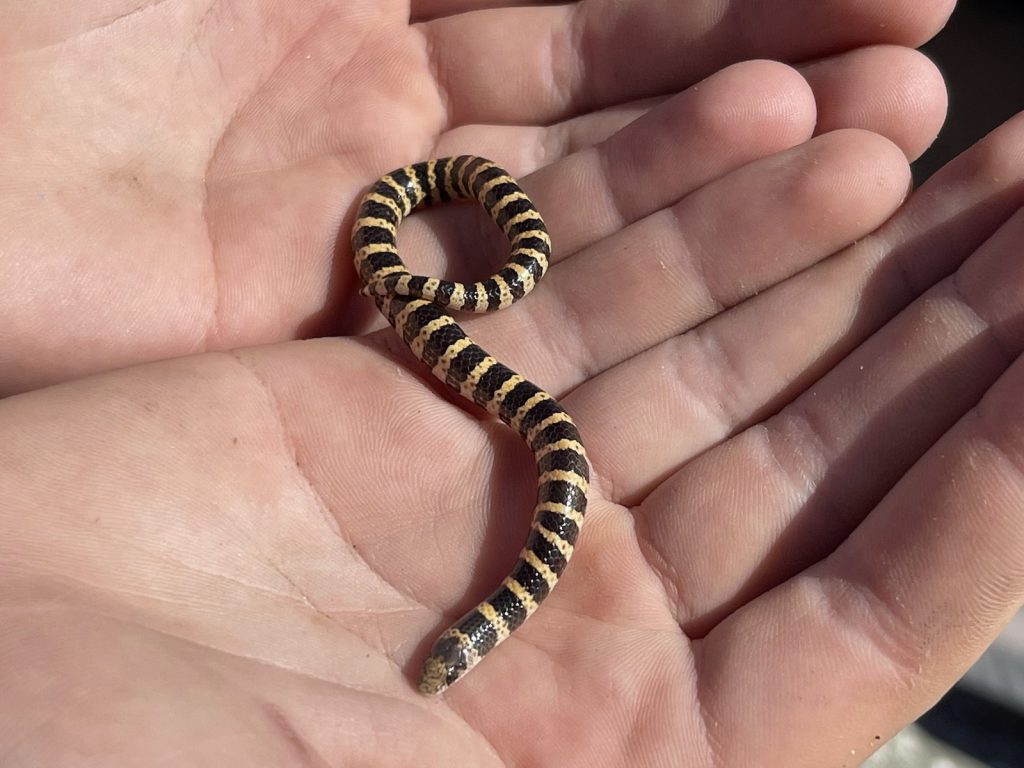
The Sand Snake (Chilomeniscus stramineus) is a small, harmless and striking snake with beautiful pigmentation. Its coloration ranges widely from orange with contrasting black bands to solid brown, or anywhere in between.
Sand Snakes are sometimes known as sand swimmers as they seemingly swim through the sand. These non-venomous cuties are nocturnal and frequently found on sand dunes or anywhere with loose soil, including even rocky outcroppings on occasion. Their tracks look like small curvy indents on the sand between bushes, sometimes littering the dunes.
Interestingly, Cerralvo Island has its own endemic species of sand snake known as Savages Sand Snake that lives only on the island and nowhere else. It’s relatively similar to the somewhat common Sand Snake that shares the mainland with us.
As for the diet of these little reptiles, they eat small invertebrates such as crickets, centipedes, cockroaches and termites. Here in the Cape Region, these snakes are active throughout the year but their peak activity is from mid-March to late August. They are very cold tolerant, and can be found still foraging throughout the night even at temperatures near 16 degrees C (61 degrees F), which is quite cold in the reptile world.
Triggerfish
Triggerfish are an interesting fish. I love the way they swim, and nap right on the sea floor in the middle of the day. They are a popular eating fish, often referred to as “Chochito.” Fish populations fluctuate, right now where I snorkel, adult triggerfish are rare to see. It is my hope this population rebounds soon! Here’s some bonus triggerfish footage to go along with the longer triggerfish video.
Orange-Throated Whiptail
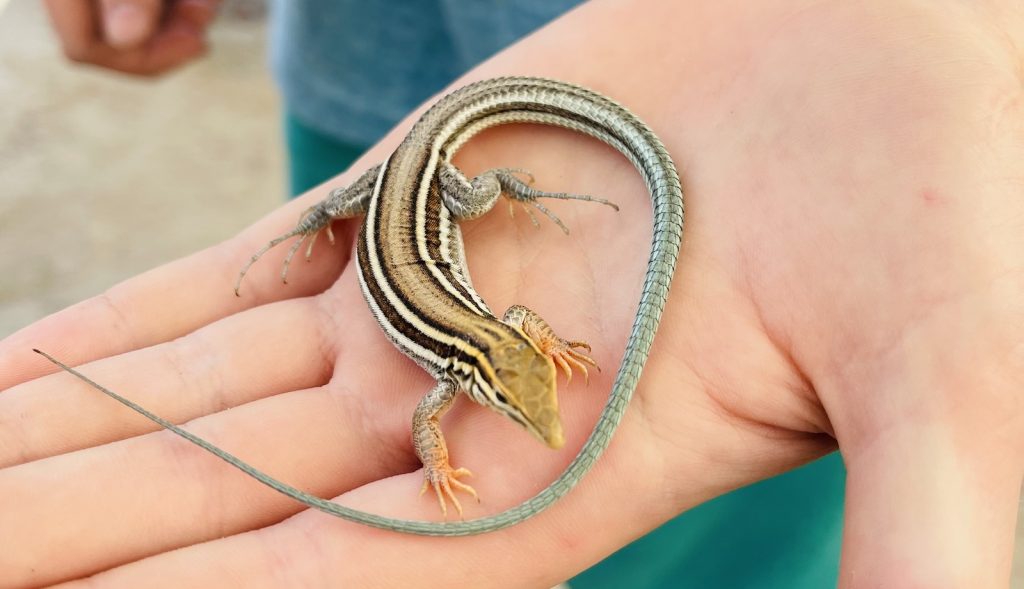
The Orange-Throated Whiptail (Aspidoscelis hyperythra) is a slender, harmless and graceful lizard with a beautiful blue tail and sometimes an orange neck. Its Spanish name is Huico (pronounced “wee-ko”).
The whiptail is extremely fast and relatively small, growing up to around 2.5 inches, not including its frequently very long tail, which is composed of segments and is sometimes longer than the lizard itself! When being attacked by a predator, the tail can break off at any one segment to confuse the enemy and help the lizard escape. The tail grows back over time.
Its diet is mostly termites but also sometimes cockroaches, spiders and moths. It is more active during the summer months. In the winter, in La Ventana we mostly see juveniles and occasional adult females, but rarely adult males.
This striking local resident is diurnal and prefers relatively dense vegetation but can be readily observed in dry grass fields and frequently yards. During warm, sunny or overcast days, however, they can be seen foraging in the leaf litter. Unlike many human residents, whiptails seem to prefer low or no-wind days.
Baja California Coachwhip
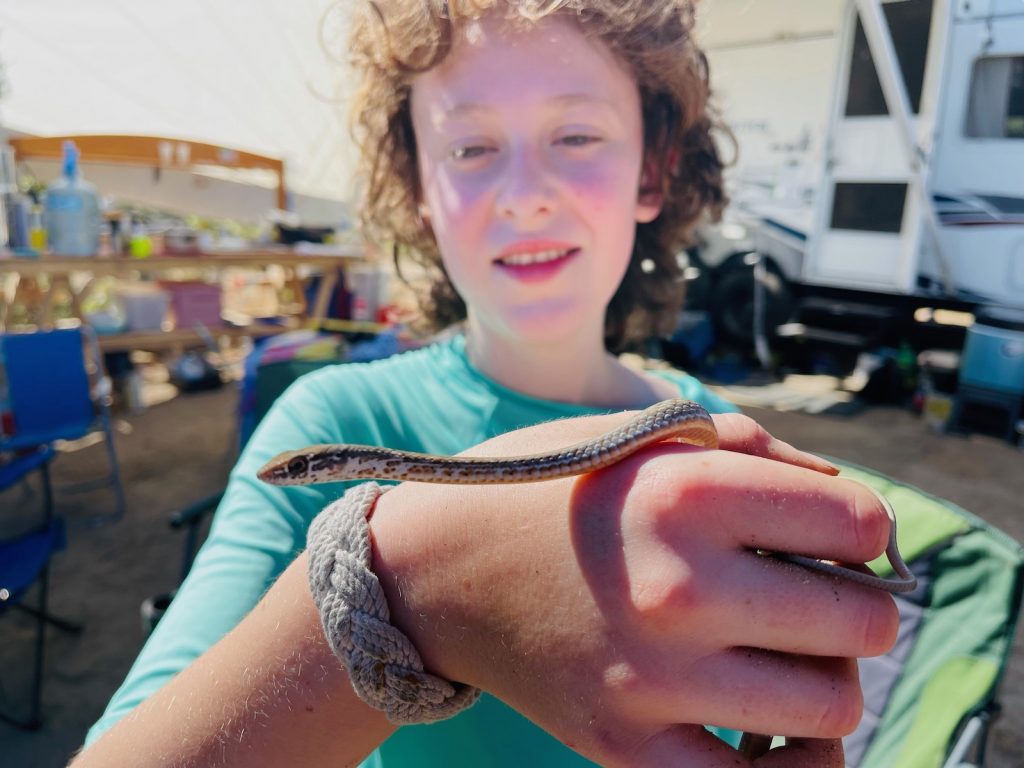
The Baja California Coachwhip (Masticophis fuliginosus) is probably the most common snake in La Ventana and the surrounding region. The photo below shows me holding a juvenile Coachwhip that I found in a brush pile a few weeks ago, in early January.
This slender, harmless, non-venomous snake is diurnal, quite fast and, like many snakes, elusive.
Normally, adults have black-colored heads, with their bodies fading to gray towards the tail. Juveniles are more brownish, like the one in the photo. They are one of La Ventana’s longest snake species. Adults range in size from four feet up to eight feet long.
Like many other local snakes, this species is most active during the summer months. During warm, sunny winter days, however, these snakes can be found out and about. Look for them in brush piles, under rocks and flat scraps like discarded wood planks, cardboard, carpet remnants, etc.
Overall, Baja California Coachwhips are beautiful and amazing snakes and, as long as we don’t bother them, they won’t bother us!
Male Hogfish Friend Story
I observed and photographed a Male Mexican Hogfish over a 30-month period. This six minute video provides a tiny keyhole view of normal moments in the life of a Mexican Hogfish, living in Ventana Bay. For those that enjoy photography, I wanted you to know that I donated 45 photographs on display at Sara Vargas’s wonderful Art studio in Plaza del Teso. The proceeds to be split 50/50 between Sara’s Studio and Azul Cerralvo, a local foundation that helps famlies in need. Each photo is unique to my project started in the fall of 2017 called, Observing Baja Coral Reef Fish – using photography to observe and learn about sea life. Drop by Sara’s studio to see the photos. Her studio is located in Plaza Del Teso next to Kjote Coffee Shop.
Fanged Panama Blenny
A Fanged Panama Blenny eats algae and phytoplankton and are reef dwellers that have fangs for defensive purposes. It can inject an opiod like chemical that lowers the blood pressure by 40% of the predator pursuing them, likely subduing it enough for the Blenny to swim off. Here’s an article if you’d like to read more about this interesting adaptation.
The Blue Razorfish
This fish has an unusual defense against predators. I became curious about it, so I set out to document this. My initial goal was to be able to end up with a decent still photo so I can ID the fish, and examine its physical construction. If I can capture it on video, then I can observe it’s behavior and watch how it physically propels itself through the water. Note: I have not seen any Blue Razorfish lately when I snorkel in Ventana Bay. So if you see one, you’re a lucky snorkeler. Please, let me know if you do! (Be sure to watch this video in HD to really appreciate the detail)
Sergeant Majors
Sergeant Majors are one of the more reproductively active fish in Ventana Bay, reproducing consistently for most of the year. They excavate down to uncover large smooth boulders to lay their eggs on. Their nests are easy to spot when you are snorkeling because multiple nests can be found in clusters of around 5-9 nests, and also, there’s a lot of activity to witness. The male protects the nest by darting around, chasing predator fish away from the nest. With this activity and that of the pair reproducing in a way that looks like a dance, you can’t miss them if you are snokeling in the bay.
Grumpy Finespotted Jawfish
Finespotted Jawfish excavate a tunnel down into the sand. They back their tail and trunk into the hole and most often can be scene with their head visible within the opening of the tunnel. As you swim over, the fish will track you with their eyes, and you can sometimes see the head turn to follow you as you cross over their path. Watch!